ECO-3695 · REV D · effective September 27, 2026
Automation & RoboticsRELEASEDEngineering notice
Toyota Plans Humanoid Robot Deployment at Canadian Plant
Toyota says it will deploy humanoid robots at a Canadian assembly plant, but the automaker has not confirmed the site, the robot supplier, or the deployment timeline — an intention, not a program.
Scope of change
- Toyota announced an intention to deploy humanoid robots at a Canadian assembly plant; no site, robot count, supplier, or timeline was disclosed
- Toyota's Canadian assembly operations are concentrated at TMMC's Cambridge and Woodstock, Ontario plants, which build the RAV4 and Lexus RX/NX
- OEM humanoid announcements to date — including BMW's Figure pilot and Mercedes-Benz's Apptronik tests — remain pilots rather than confirmed production programs
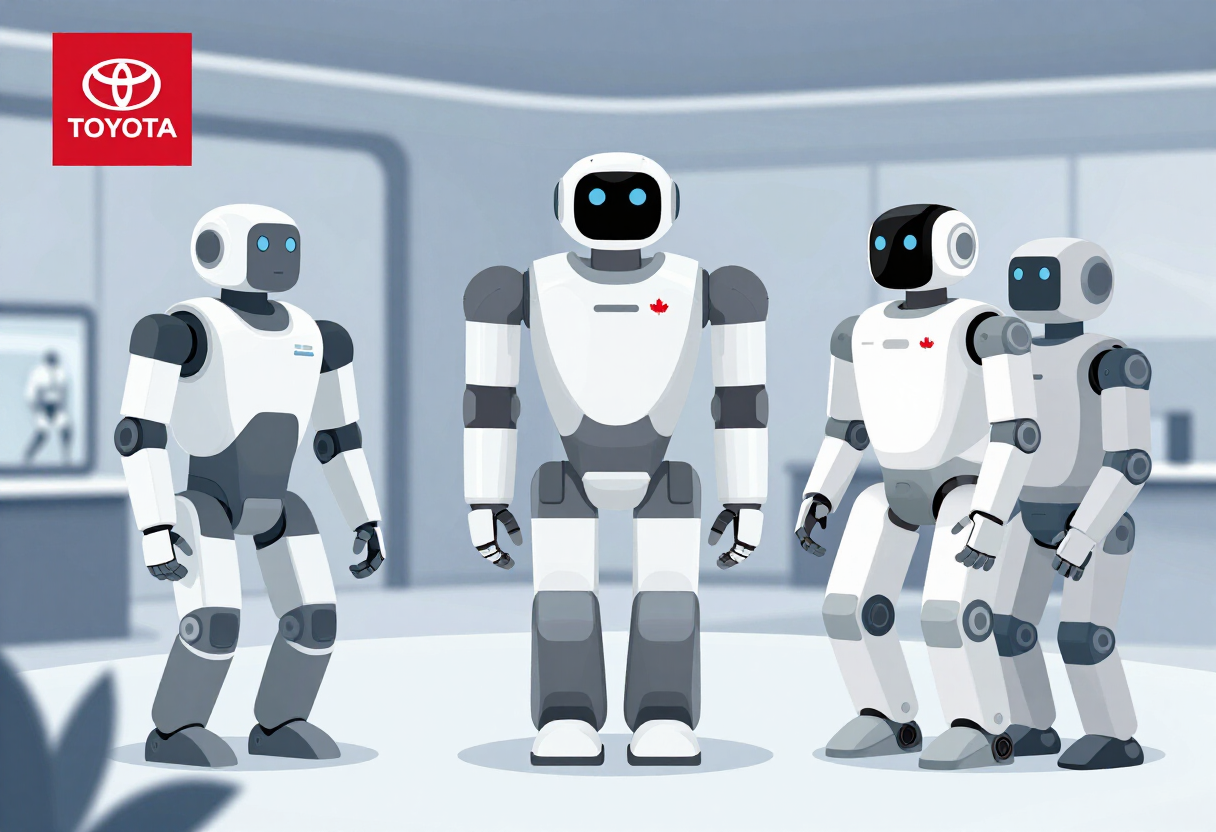
Toyota intends to put humanoid robots to work at one of its Canadian assembly plants, according to a report from Assembly Magazine. The headline number in this story is not yet a unit count or a headcount — it is a program status: this is an announced intention, not a confirmed production deployment, and Toyota has not publicly specified which plant, how many robots, or on what timeline.
That gap matters for manufacturing planners tracking the automaker's automation roadmap. Toyota operates two assembly plants in Ontario — Cambridge and Woodstock — both within the Toyota Motor Manufacturing Canada (TMMC) complex that builds the RAV4 and Lexus RX and NX lines. Assembly Magazine's report did not name the site, the robot supplier, or the tasks the humanoids would perform, so any assumption about weld shop, final assembly, or material handling roles would be speculation at this stage.
The announcement places Toyota among a small group of OEMs publicly exploring general-purpose humanoids on factory floors. BMW has piloted Figure AI's Figure 01 robots at its Spartanburg, South Carolina plant. Mercedes-Benz has tested Apptronik's Apollo robots in Hungary. Honda, Toyota's domestic rival, has long researched humanoid form factors through its ASIMO program without putting them into series production work. Toyota itself is no stranger to robotics — its Partner Robot division dates back two decades — but factory deployment of human-form machines would mark a shift from fixed automation and dedicated cobots toward flexible, mobile labor units.
For tier-one and tier-two suppliers watching this space, the signal is worth noting but not yet actionable. Humanoid deployments announced by OEMs to date have been pilots and proofs of concept, not capacity commitments. No automaker has publicly committed to a production-line humanoid program with defined volumes, cycle-time targets, or takt integration. Claims about labor substitution or shift reduction should be treated accordingly — verified production data does not yet exist for humanoids in automotive assembly at scale.
The economics remain the open question. A humanoid must compete not with a human worker's fully loaded cost alone, but with the established alternatives: six-axis industrial robots that weld and paint at fractions of a cent per operation, autonomous mobile robots that already move material through Toyota's plants, and collaborative arms priced below $50,000 in some configurations. Humanoids promise flexibility across tasks designed for human proportions — seats, harnesses, interior trim — which is precisely where conventional automation struggles. Whether that flexibility justifies the per-unit cost is what pilots like Toyota's are designed to answer.
Canadian context adds a policy dimension. Ontario's auto sector has drawn major EV and battery investment commitments in recent years, and labor availability at assembly plants in Cambridge and Woodstock has been a recurring theme in contract negotiations with Unifor, which represents hourly workers at TMMC. Any robotic deployment that touches job classifications or headcount would move through that negotiation channel — another reason to distinguish stated intent from an executed program.
What to watch next: whether Toyota names the plant and the robotics partner, whether the deployment proceeds from pilot to sustained production tasks with published cycle-time data, and whether Unifor or Toyota Canada confirms any impact on staffing levels. Until those details land, this belongs in the intentions column, not the capacity column.
via Google News: Automotive assembly automation (Source)
More from Sophie Lindqvist
Show full bio
Correspondent covering business strategy at Autoplant Brief.
97 articles