ECO-3880 · REV E · effective October 9, 2026
Automation & RoboticsAPPROVEDEngineering notice
Humanoid Robots Assigned New Role at BMW's U.S. Assembly Plant
BMW has assigned humanoid robots a new, defined role at its U.S. assembly plant, moving the machines from demo work toward production-line tasks.
Scope of change
- BMW has assigned humanoid robots a new role at its U.S. assembly plant, Assembly Magazine reports.
- The deployment moves humanoids beyond demonstration work into a defined factory-floor function.
- The report does not specify unit counts, the robotics supplier, or the workstations involved.
- BMW's U.S. assembly operations center on its Spartanburg, South Carolina, complex.
- Unit counts, line assignments and workforce-planning statements are the markers that will confirm the program's scale.
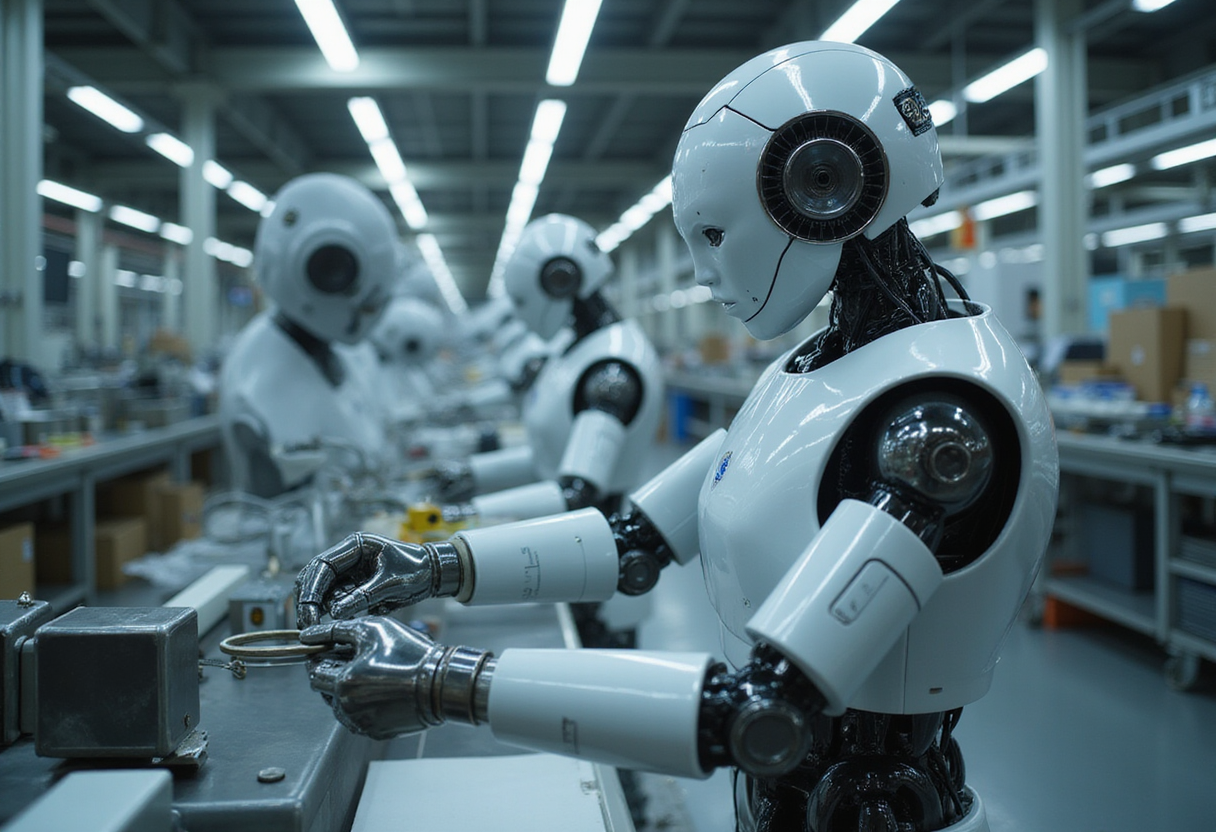
BMW has given humanoid robots a new role inside its U.S. assembly plant, moving the machines beyond demonstration work into a defined function on the factory floor, Assembly Magazine reports.
The headline fact is the role change itself. Automakers have tested humanoid robots repeatedly over the past several years, but those trials mostly stayed in lab conditions or short pilot windows. A new, named role at a high-volume assembly operation marks a different stage in the adoption curve — one where the machine has a job description rather than a demo script.
BMW's U.S. assembly operations anchor around its Spartanburg, South Carolina, complex, the company's largest plant by export volume and the production home of its X-model lineup. Any humanoid deployment inside that footprint carries weight precisely because Spartanburg runs at mass-production scale. A robot that performs a repeatable task there faces cycle times, safety zoning and line-side logistics that pilot cells rarely replicate.
What do we actually know?
The report confirms the core development: humanoids at BMW's U.S. assembly plant have taken on a new role. The announcement arrives through supplier and vendor channels, which trade practice treats as claims to verify against production data.
What the report does not specify, at this stage:
- The number of humanoid units assigned to the new role
- The identity of the robotics supplier behind the machines
- The specific workstations or production zones involved
- Whether the role covers a full shift cycle or operates alongside human operators in staggered intervals
- Any timing commitment for scaling the deployment across additional lines
Those gaps matter. In automotive robotics, the distance between "assigned a role" and "validated at takt" is where most humanoid programs currently sit. Cycle-time data, uptime rates and integration cost per station remain the numbers that separate a production asset from a showcase.
Why the role change matters
Humanoid form factors carry a specific industrial argument: they fit into workcells, tooling and ergonomics designed for people. That is the entire commercial premise. A traditional six-axis arm requires re-engineering the station around it. A humanoid, in theory, slots into the station as built.
That argument only pays off if the machine holds up under production conditions. Automotive plants run repetitive, safety-governed, quality-audited processes. A humanoid that performs a task at inconsistent speed, or that requires frequent intervention, consumes more engineering time than it saves.
This is why the "new role" framing deserves attention. Roles get assigned when a plant trusts a machine with a defined output. Demos get scheduled when a plant wants to observe one.
The supplier-tier context
BMW sits at OEM tier in this deployment, with the robotics vendor acting as an equipment supplier to the program. In trade-press terms, that makes the announcement a supplier claim about OEM adoption. The verification path runs through BMW's own production reporting — line assignments, shift integration, and any subsequent capacity or headcount statements tied to the automation.
OEMs rarely announce a humanoid role without internal validation data behind it. They also rarely disclose that data. The result is a familiar pattern in manufacturing automation: a confirmed operational change, published without the performance metrics that would let outsiders judge its economics.
How this fits the broader adoption picture
Across the auto industry, humanoid robotics programs have moved through three phases: laboratory demonstration, controlled pilot on a working line, and assigned operational role. Most programs announced since 2023 have occupied the first two phases. The BMW development, as reported, places a deployment at the third phase within a U.S. assembly plant — the phase where duty cycles, maintenance intervals and safety certifications start generating real engineering data.
The assembly-plant setting also matters more than a powertrain or stamping assignment would. Final assembly remains the most labor-intensive, least-automated zone of vehicle production. Robots already dominate welding and painting; they hold a far smaller share of trim, chassis marriage and final-line tasks. Any automation advance in assembly strikes at the plant's highest labor-cost concentration.
What to watch next
Three markers will tell whether this role assignment hardens into a program:
- BMW or its robotics partner disclosing unit counts assigned to the Spartanburg-area operations
- A named production line or model program integrated into the humanoid work scope
- Any BMW statement tying the deployment to capacity, shift structure or workforce planning at the plant
Until those appear, the confirmed fact stands on its own: humanoids at BMW's U.S. assembly plant now hold a defined role, and the industry's most-watched automation experiment has moved one step closer to the takt time.
via Google News: Automotive assembly automation (Source)
More from Daniel Okafor
Show full bio
Senior reporter covering marketplaces and e-commerce at Autoplant Brief.
176 articles