ECO-8427 · REV B · effective September 29, 2026
Automation & RoboticsRELEASEDEngineering notice
Google's Intrinsic Open-Sources Robot Control and Vision Software
Google's Intrinsic releases ROS-compatible control, vision and motion software under Apache 2.0, after challenge teams hit 100% success on cable insertion tasks.
Scope of change
- Intrinsic Core released under Apache 2.0 license via GitHub, including ROS-compatible control, motion and grasp planning, machine vision and simulation components
- Two teams achieved 100 percent success rate in final physical-robot testing of flexible cable insertion during Intrinsic's AI for Industry Challenge
- Open Machine Tending Solution reference application supports customization for FANUC and Universal Robots CNC tending systems
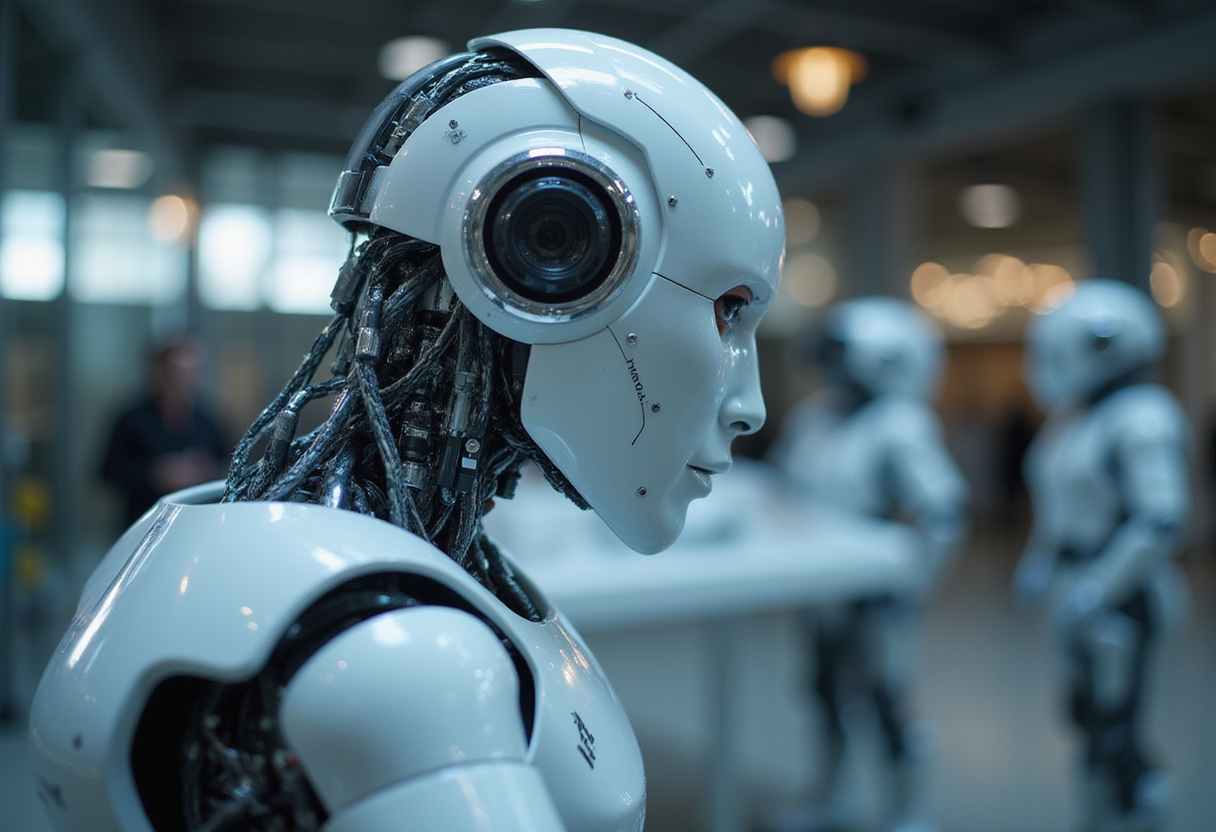
Two developer teams achieved a 100 percent success rate automating flexible cable insertion on a physical robot — that is the headline number behind Intrinsic's decision to open-source core components of its industrial robotics platform.
Intrinsic, the Mountain View, Calif.-based industrial robotics software company owned by Google, is releasing Intrinsic Core under an Apache 2.0 license. The package includes ROS-compatible software for robot control, motion and grasp planning, machine vision, simulation and hardware integration. It is available now through the company's GitHub repository.
The company says the components draw on capabilities it already runs in manufacturing deployments. The intent is to hand robotics developers reusable building blocks instead of forcing them to build basic robot infrastructure from scratch for every application.
What is in the package
Intrinsic Control provides a hardware-agnostic, real-time control framework that can adjust robot behavior during a trajectory based on sensor feedback. Its architecture lets developers swap robot arms, grippers and sensors without rewriting hardware drivers — a common cost driver in retooling lines.
The release also includes automated motion planning that generates collision-free robot paths, and grasp planning that adapts to the position and orientation of parts. Pose estimation builds on NVIDIA FoundationPose, allowing robots to locate and manipulate 3D parts dynamically. That capability could cut the need for rigid physical fixtures, one of the persistent expenses in high-mix assembly.
Intrinsic Core adds simulation services based on Gazebo, automated camera calibration, and preconfigured ROS-compatible drivers for supported robots, grippers and 3D cameras.
Tested on a hard problem
Intrinsic recently put parts of the stack through its AI for Industry Challenge, which asked developers to automate the insertion of flexible cables into corresponding ports. Cables bend and move unpredictably, which makes the task notoriously difficult to automate reliably.
According to Intrinsic, two teams reached a 100 percent success rate in final testing on a physical robot. Participants combined several of the same software building blocks now shipping in Intrinsic Core with AI to build their applications. Treat that result as a vendor-reported benchmark from a controlled challenge, not production-line validation — but it signals the stack can handle deformable-part manipulation, a frequent sticking point in automotive wiring and harness assembly.
Reference application for machine tending
Alongside the core release, Intrinsic is publishing an Open Machine Tending Solution as a reference application. It gives developers and integrators a starting point for AI-enabled CNC machine-tending cells and can be customized for equipment including FANUC and Universal Robots systems — two platforms common in tier-one and tier-two supplier plants.
Intrinsic frames the release as a way to help developers move robotics applications from prototype to production, the transition where many automation projects stall.
What to watch
Watch adoption metrics on GitHub — contributor count, fork activity and integrator uptake — as the first hard evidence of whether the open-source strategy gains traction. The appearance of production deployments built on Intrinsic Core, particularly in machine tending and deformable-part handling, will show whether Google's industrial software play moves beyond reference code into plant-floor reality.
via bnpmedia.com (Original)
More from Marcus Bennett
Show full bio
News editor covering marketplaces and e-commerce at Autoplant Brief.
86 articles
Also circulated
- Humanoid robots reach factory floors at BMW, Tesla and Mercedes
- From Demo to Deployment: Video Series Tests Robot Claims Against Plant Reality
- Cognex Bets $500 Million on Robotic Perception with RealSense Deal
- Hyundai Aims at $20,000 Humanoid Robots, Recruits 200 Suppliers
- Agility Humanoid Robots Enter Toyota's Production Operations