ECO-7305 · REV F · effective October 8, 2026
Automation & RoboticsRELEASEDEngineering notice
AWS Open-Sources Physical AI Toolchain for Industrial Robot Development
AWS open-sources a five-stage Physical AI Toolchain with NVIDIA integration, spanning synthetic data to edge deployment for industrial robots. RLWRLD and Config already onboard.
Scope of change
- AWS open-sourced a Physical AI Toolchain covering five development stages, from synthetic data generation to continuous improvement
- The stack integrates Amazon SageMaker, EC2 GPU instances, IoT Greengrass, Bedrock AgentCore and NVIDIA Isaac Sim, Isaac Lab, GR00T and Cosmos
- RLWRLD is developing an 8.1-billion-parameter foundation model for robotic manipulation on the platform
- Config has built a data pipeline with more than 200,000 hours of robot action data
- NEURA Robotics is using the toolchain for cognitive humanoid robots that learn from experience
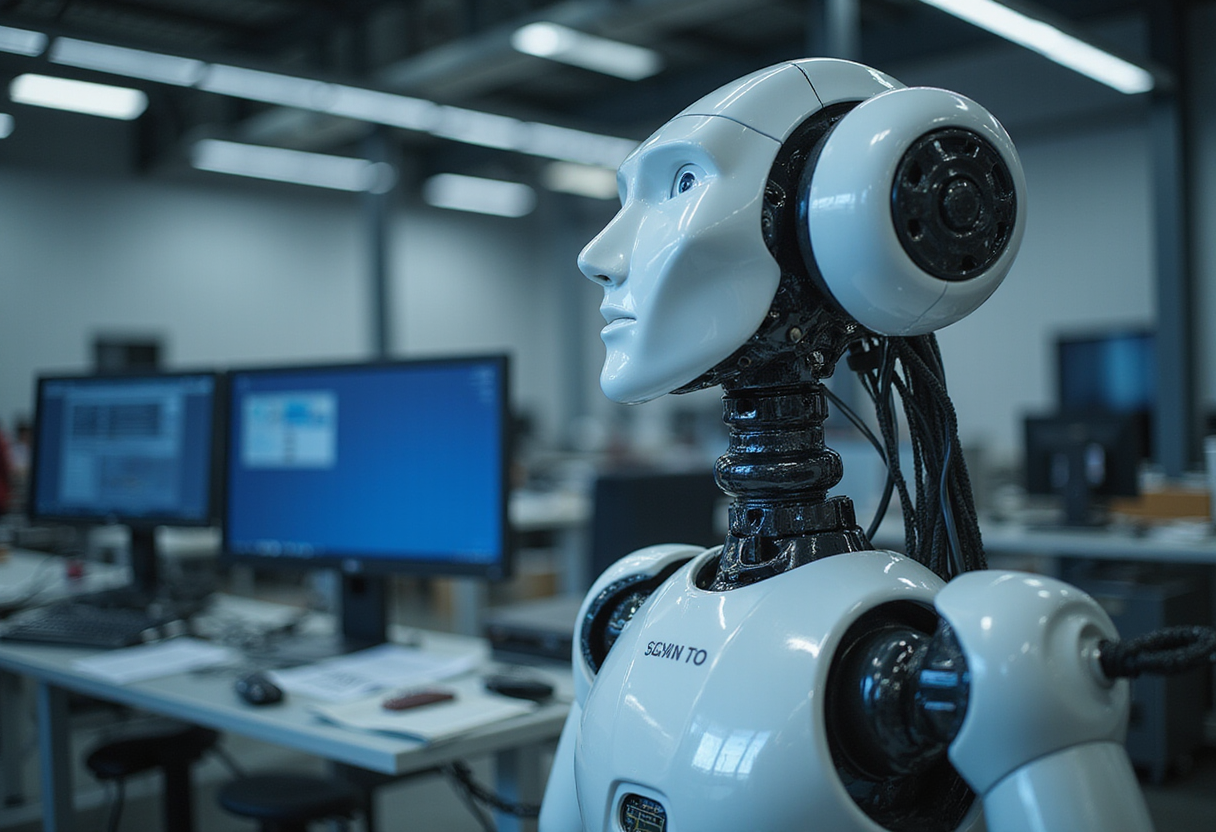
Amazon Web Services has open-sourced a Physical AI Toolchain that covers all five stages of industrial robot development — synthetic data generation, model training, simulation and validation, edge deployment and continuous improvement.
AWS announced the launch from Birmingham, Mich. The toolchain runs on AWS infrastructure and integrates NVIDIA's Physical AI technology, including Isaac Sim, Isaac Lab, GR00T and Cosmos. It targets machines that perceive their surroundings, make decisions and adapt to changing conditions on the factory floor.
The scope spans collaborative robots that learn new assembly tasks, autonomous mobile robots and humanoid systems.
What does the toolchain actually include?
The platform pulls together existing AWS services rather than new purpose-built products:
- Amazon SageMaker for model training
- Amazon EC2 GPU instances for simulation
- AWS IoT Greengrass for edge deployment
- Amazon Bedrock AgentCore for orchestration
- NVIDIA Isaac Sim, Isaac Lab, GR00T and Cosmos technologies
Developers can generate simulated training environments, train robots through human demonstrations and virtual practice, and test machine behavior before pushing models to physical equipment. Once deployed, operational data feeds back into the models for continuous improvement. Manufacturers can adopt the full stack or pick individual components that integrate with existing systems.
Why AWS built it
Uwem Ukpong, vice president of AWS Industries, framed the release around engineering capacity, not robotics capability.
"Physical AI is going to touch every industry that moves, builds, or makes things, and our customers are moving fast to capture that opportunity," Ukpong said. "We built the Physical AI Toolchain on AWS because customers told us that too much of their engineering effort was going to infrastructure instead of innovation. We want to flip that."
For plant engineering teams, that claim translates to a specific bet: shifting integration work from on-premise infrastructure to a managed cloud stack shortens the path from robot concept to deployment.
Who is already using it?
AWS named three robotics developers working with the platform, with figures attached to two:
- RLWRLD is developing an 8.1-billion-parameter foundation model for robotic manipulation, covering grasping, rotating and handling objects.
- Config has built a data pipeline holding more than 200,000 hours of robot action data that can generate additional training scenarios.
- NEURA Robotics is developing cognitive humanoid robots capable of learning from experience.
These are early-stage developer engagements, not confirmed production deployments. No OEM or tier-one supplier plant adoption was announced alongside the launch, so manufacturing uptake remains an intention to verify against actual deployments.
What to watch next
The open-source release means the barrier to trial is low — any integrator can download the stack and test it against existing simulation pipelines. The metrics that will matter are deployment counts on real assembly lines, cycle-time gains from robots trained on synthetic data versus traditional programming, and whether the RLWRLD foundation model and Config's 200,000-hour dataset translate into measurably faster task training at automotive plants.
via bnpmedia.com (Original)
More from Grace Kim
Show full bio
Staff writer covering industry trends and analytics at Autoplant Brief.
84 articles
Also circulated
- Google's Intrinsic Open-Sources Robot Control and Vision Software
- Humanoid robots reach factory floors at BMW, Tesla and Mercedes
- Sanctuary AI Reports Physical AI Validation at Tier 1 Auto Supplier
- Hyundai Targets 25,000 Atlas Humanoids as Boston Dynamics Opens Metaplant Center
- From Demo to Deployment: Video Series Tests Robot Claims Against Plant Reality