ECO-8855 · REV P · effective October 15, 2026
Automation & RoboticsRELEASEDEngineering notice
Industry Next Opens 10,000-SqFt Arena to Train Physical AI Robots
Industry Next opened a 10,000-sq-ft San Francisco arena with 50+ robots to train physical AI for industrial automation. The site backs a BMW pilot on dexterous manipulation and the open Sim2World benchmarking platform.
Scope of change
- Industry Next opened a 10,000-square-foot arena in San Francisco housing more than 50 robots for physical AI development.
- The Real2Sim2Real Arena serves as the physical foundation of Sim2World, an open benchmarking platform for sim-to-real robot policies.
- BMW Group is Industry Next's first publicly confirmed OEM partner, evaluating AI-powered dexterous manipulation for manufacturing.
- CEO Lukas Pankao said simulation is the most data-efficient path to solving physical AI but bridging it to real-world deployment remains open.
- Industry Next claims its technology could let a manufacturer retool a production line in minutes rather than weeks.
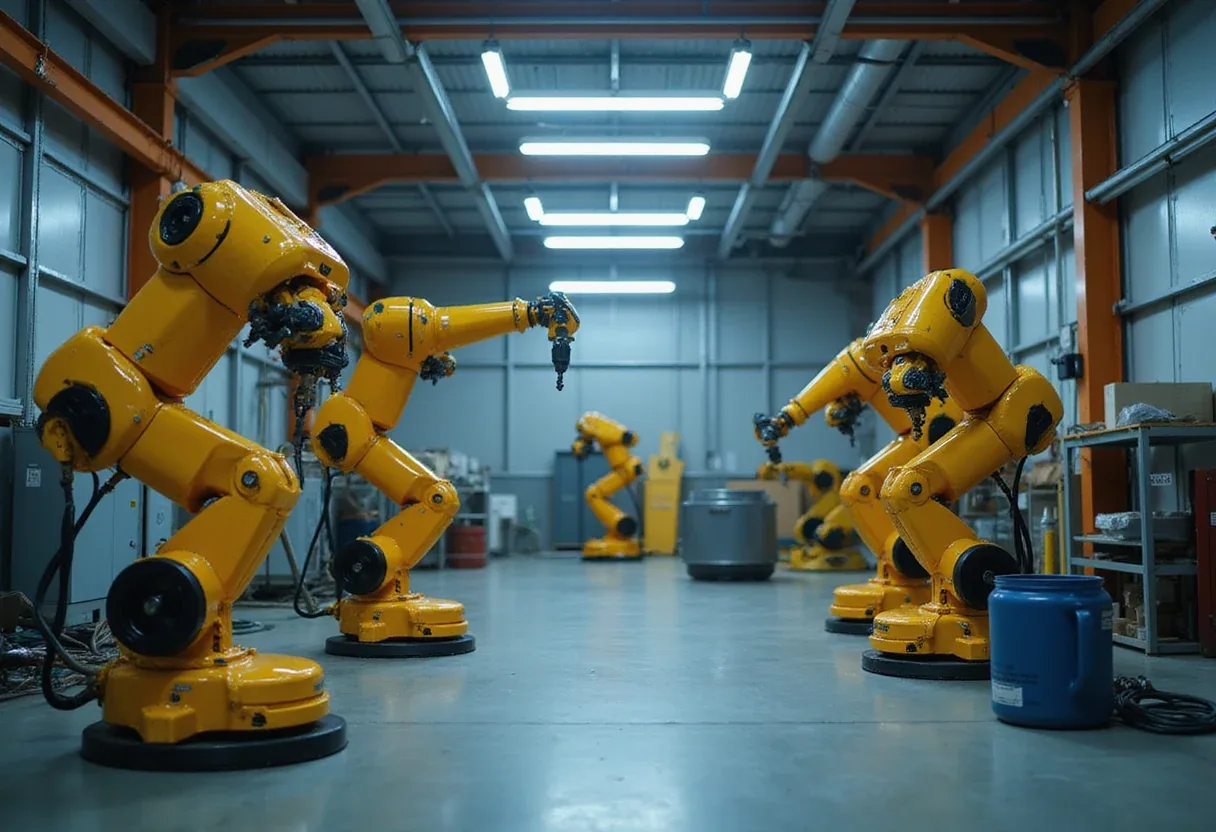
Industry Next has opened a 10,000-square-foot robotics arena housing more than 50 robots at its San Francisco headquarters. The facility, branded the Real2Sim2Real (R2S2R) Arena, aims to develop and validate physical AI — software that drives machines through perception, planning and motion rather than scripted step sequences — for industrial automation.
What is in the R2S2R Arena?
The space unites three previously separate workflows: simulation, robot learning and real-world deployment. Robots inside include mobile bimanual setups (pairs of arms mounted on a moving base) and stationary industrial stations, all fitted with dexterous hands for manipulation research.
The arena runs a closed data loop. Every real-world task a robot executes inside the building is recreated in simulation. That simulation scales the training and validation of physical AI models. The output is "policies" (the decision-making core that turns a camera image and joint state into a specific motion) proven again on the physical robots inside the same facility.
"We believe simulation is the most data-efficient path to solving physical AI, yet bridging it to the real world remains an open challenge," Lukas Pankao, co-founder and CEO of Industry Next, said. "Impressive demos often fail at deployment, and closing that gap requires open collaboration across startups, industry and academia."
What changes for production engineers?
Industry Next builds AI-driven, self-contained robotic production stations powered by proprietary foundation models (large general-purpose AI systems fine-tuned for vision, task context and motion). The company says its technology could let a manufacturer retool a production line in minutes rather than weeks, removing conventional robot programming from the changeover (model-to-model switchover) workflow.
The tasks the company targets — delicate assembly, intricate manipulation and other work that has traditionally required human hands — are precisely the ones that have resisted fixed-sequence automation. The arena exists to stress-test those policies under repeatable, instrumented conditions before they reach a line.
What does it mean for the BMW partnership?
The facility also serves as the physical foundation of Sim2World, an open benchmarking platform. Through Sim2World, startups, academic labs and industry teams contribute tasks, train policies and validate results on real robots. Buyers gain comparable metrics across vendors rather than relying on marketing demos.
Industry Next's first publicly confirmed OEM (the brand-name vehicle maker) partner is BMW Group. The two are evaluating AI-powered dexterous manipulation for manufacturing. BMW has not disclosed the plant, program or timeline.
For automotive manufacturers, the R2S2R Arena signals a shift in how AI-driven automation will be procured. Validation moves from factory trials to instrumented arenas where policies benchmark head-to-head. Plants running high-mix or low-volume programs are the most likely early beneficiaries if the minutes-not-weeks reconfiguration claim holds up outside the controlled environment.
What should engineers and buyers watch next?
Industry Next has not published reconfiguration time, cycle data or a deployment date for the BMW evaluation. The next milestones are the first Sim2World benchmark results, the plant and program tied to the BMW work, and any announcement of a second OEM customer.
Production engineers weighing AI-driven stations should ask vendors for validated policy performance on their own parts, not just the vendor's preferred test set. The minutes-not-weeks reconfiguration claim will need line-level proof before it changes a tooling budget.
via bnpmedia.com (Original)
More from Marcus Bennett
Show full bio
News editor covering regulation, policy and their impact on Automotive manufacturing and vehicle production at Autoplant Brief.
195 articles
Also circulated
- Google's Intrinsic Open-Sources Robot Control and Vision Software
- AWS Open-Sources Physical AI Toolchain for Industrial Robot Development
- Humanoid robots reach factory floors at BMW, Tesla and Mercedes
- Sanctuary AI Reports Physical AI Validation at Tier 1 Auto Supplier
- From Demo to Deployment: Video Series Tests Robot Claims Against Plant Reality