ECO-1562 · REV E · effective September 30, 2026
Automation & RoboticsAPPROVEDEngineering notice
Deere and Mercedes-Benz Place Bets on Humanoid Robots
Deere and Mercedes-Benz are investing in humanoid robots, betting general-purpose machines can fill automation gaps in high-variation assembly work.
Scope of change
- Deere and Mercedes-Benz have both invested in humanoid robots, Assembly Magazine reports
- Neither the investment size nor the robotics partners were disclosed in the report
- No production timeline or specific plant deployment has been confirmed
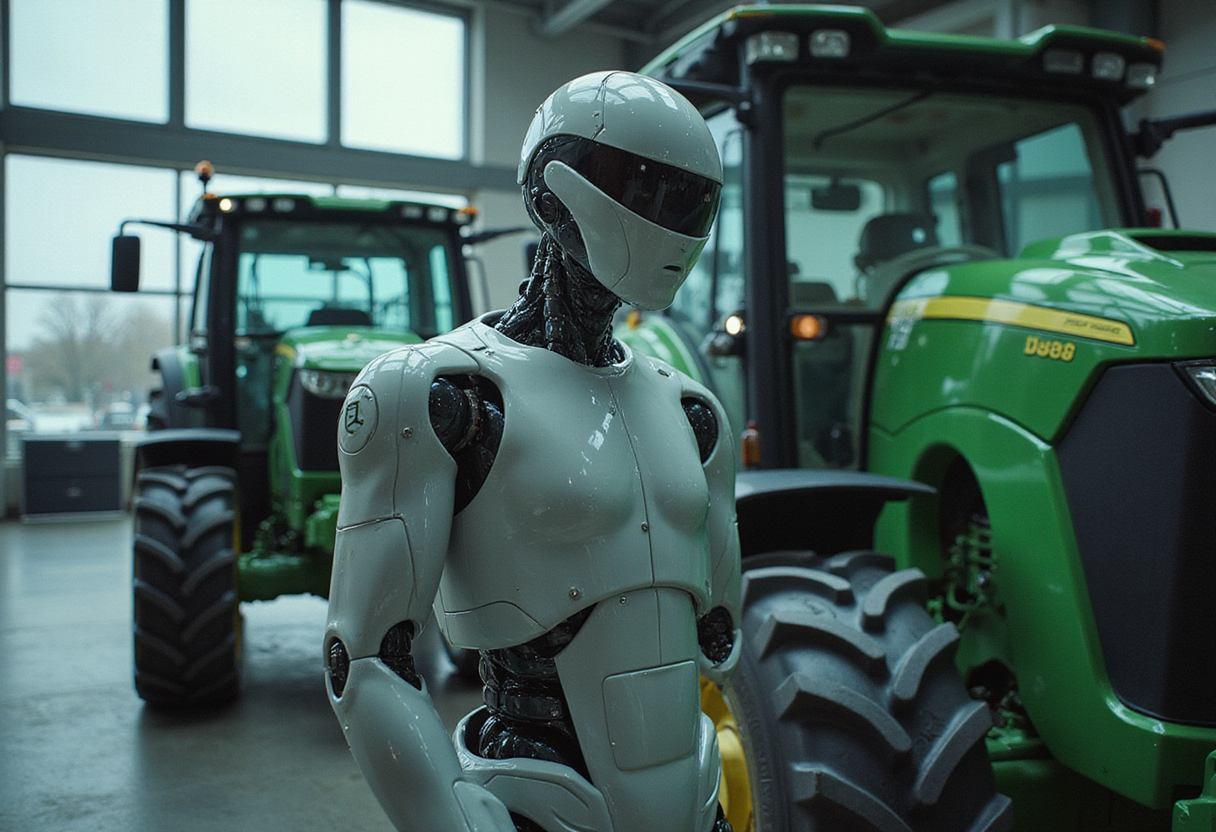
Deere and Mercedes-Benz have both moved to invest in humanoid robots, according to a report from Assembly Magazine. The two companies operate in very different segments — agricultural and construction machinery on one side, premium passenger vehicles on the other — but the shared direction of their capital points to the same question on the factory floor: whether general-purpose bipedal machines can do work that today requires fixed automation or human labor.
For Mercedes-Benz, the interest fits an established pattern. The automaker has been among the more visible OEMs experimenting with humanoid platforms in its production network, exploring whether robots built to approximate human proportions can work around tooling, fixtures, and workstations designed for people. The appeal is straightforward. A conventional industrial robot arrives with installation costs, safety fencing, and engineering time; a humanoid that can slot into an existing station inverts that economics if — and the conditional carries most of the weight — the hardware proves reliable at cycle times that matter.
Deere's involvement carries a different logic. The company's plants build large, low-volume, high-variation products: tractors, harvesters, excavators. That mix has always resisted heavy fixed automation, because the tooling rarely pays back across a model range that changes constantly. If a humanoid can be re-tasked by software rather than re-tooled by engineers, it addresses the exact automation gap that has kept much agricultural-equipment assembly dependent on manual labor. An investment, in that context, is less a procurement decision than a research position — a way to steer the technology roadmap toward Deere's use cases before the machines are ready to buy at scale.
What the report does not yet establish is the size of either commitment, the identity of the robotics developers receiving the money, or a production timeline tied to specific plants. Those are the details that separate a strategic signal from a program. In the automotive-supplier world, humanoid-robot announcements have multiplied over the past two years, and the pattern is consistent: demonstration videos first, pilot placements second, volume deployments a distant and often shifting third. Any OEM investment should be read against that track record.
The verification questions for manufacturing planners are concrete. Which tasks are the machines proposed to take over — material presentation, quality inspection, fastening, handling? What duty cycle and mean time between failures do the developers claim, and what do early plant trials actually show? How does the unit economics case stack up against a collaborative arm plus a human operator, which remains the default answer for most flexible assembly work? Until those numbers surface, capacity plans built around humanoids remain intentions, not commitments.
There is also a labor dimension both companies will have to manage. Deere has faced high-profile labor disputes in recent years, and any move toward machines that substitute for assembly workers will draw scrutiny from unions and from the communities around its Midwest plants. Mercedes-Benz faces a different constraint: works-council dynamics in Germany make deployment strategy as much a negotiation as an engineering decision.
What to watch next: the naming of the robotics partners, the scale of each investment, and the first confirmed pilot placement on a specific line — the moment a humanoid is assigned a station, a shift, and a measurable output target inside a Deere or Mercedes-Benz plant. That is when this story moves from portfolio positioning to production data.
via Google News: Automotive assembly automation (Source)
More from Grace Kim
Show full bio
Staff writer covering industry trends and analytics at Autoplant Brief.
82 articles