ECO-3825 · REV N · effective October 9, 2026
Automation & RoboticsRELEASEDEngineering notice
ABB E-Device Lets Plant Engineers Run Robots From Own Tablets
ABB Robotics launches E-Device safety interface that lets manufacturers program, operate and monitor OmniCore-controlled robots and cobots from standard tablets and PCs. ISO 10218:2025 compliant.
Scope of change
- E-Device meets ISO 10218:2025 industrial robot safety standard on launch
- Unit carries CE marking for Europe and UL certification for North America
- Hardware includes physical emergency-stop button and three-position enabling switch
- Runs same OmniCore user interface across ABB robot and cobot portfolio
- ABB did not disclose specific time or cost savings figures for the device
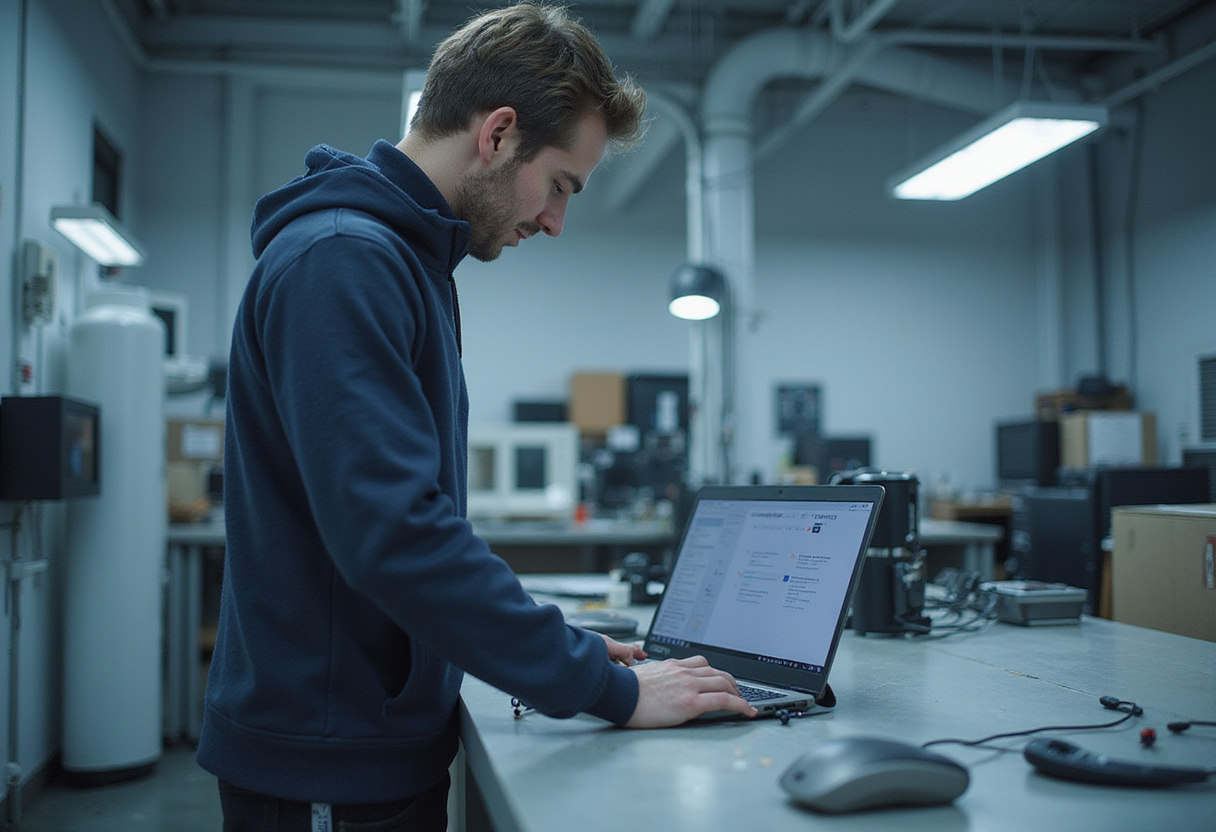
AUBURN HILLS, Mich. — ABB Robotics has introduced a compact safety interface that lets plant engineers program, operate and monitor OmniCore-controlled robots and cobots from standard commercial tablets and PCs, with compliance to the ISO 10218:2025 industrial robot safety standard secured on launch.
The unit, branded E-Device, carries CE marking for Europe and UL certification for North America. It integrates a physical emergency-stop button and a three-position enabling switch for manual robot operation — two hardware elements that distinguish a commercial-grade tablet in a risk-rated cell from an ordinary handheld computer on a factory floor.
The device plugs into ABB's OmniCore controller family, the platform the company has been standardising its robot and cobot lines around. Running the same OmniCore user interface across that portfolio means a worker trained on one cell can move to another without relearning menus — a recurring pain point on automotive lines running mixed fleets from a single supplier.
"Customers are looking for ways to quickly and easily customize and build solutions that can be readily adapted and scaled as their needs change, without the need to spend time learning how to use new interfaces or programming," said Marc Segura, president of ABB Robotics.
What does the E-Device actually do?
Engineers write and simulate routines offline in ABB's RobotStudio software, then carry the same tablet or PC to the cell for deployment and commissioning. The same mobile device can be moved between E-Device-equipped systems in plants running mixed robot families.
ABB argues the shared UI cuts training requirements when staff rotate between cells, and shortens engineering and commissioning cycles during new-program ramp-ups. The company did not provide specific time or cost savings figures.
What safety and compliance claims does ABB make?
Three certifications anchor the launch:
- ISO 10218:2025, the updated industrial robot safety standard
- CE marking for the European market
- UL certification for North America
The hardware-side safety chain — the e-stop and three-position enabling device — is what allows a consumer-grade tablet to act as a programming terminal inside a risk-rated industrial environment rather than a separate teach pendant. That distinction matters for plants standardising on a single mobile device across cells.
How does it fit ABB's software stack?
Users can also open AppStudio, ABB's no-code environment for building application-specific interfaces on top of the OmniCore platform. Pairing RobotStudio's offline simulation with AppStudio's custom front-ends targets manufacturers retooling cells without dedicated robot programmers on staff — a recurring constraint in tier-one stamping, body-in-white and battery-assembly operations.
What to watch next
- Named launch customers: ABB did not disclose which plants will take first delivery.
- Productivity benchmarks: the company has not published commissioning-time or training-time figures tied to E-Device deployments.
- Competitive response: Fanuc, Yaskawa and Kuka all offer PC-based or tablet-based programming options; ISO 10218:2025 compliance may become a procurement filter for automotive tier suppliers in 2025 contracts.
- Integration depth: whether ABB extends the shared OmniCore UI to cells without the E-Device, or opens the interface to third-party controllers.
via bnpmedia.com (Original)
More from Marcus Bennett
Show full bio
News editor covering marketplaces and e-commerce at Autoplant Brief.
148 articles
Also circulated
- ABB Pushes Smart Robotics Into Automotive Logistics
- A3 Releases Final Part of R15.08 Industrial Mobile Robot Safety Standard
- Humanoid robots reach factory floors at BMW, Tesla and Mercedes
- Google's Intrinsic Open-Sources Robot Control and Vision Software
- AWS Open-Sources Physical AI Toolchain for Industrial Robot Development