ECO-4675 · REV L · effective September 27, 2026
Auto Industry PolicyRELEASEDEngineering notice
U.S. Auto Industry Urges Trump to Block Chinese Vehicles
U.S. automakers and suppliers have asked the Trump administration to ban Chinese vehicles outright, escalating beyond tariffs and forcing a decision with plant-level consequences.
Scope of change
- The U.S. auto industry has formally asked the Trump administration to ban Chinese vehicles from the U.S. market, Axios reported
- An outright ban would escalate beyond existing tariffs on Chinese vehicle imports
- Retaliation risk falls on U.S.-aligned automakers and suppliers with Chinese production or export exposure
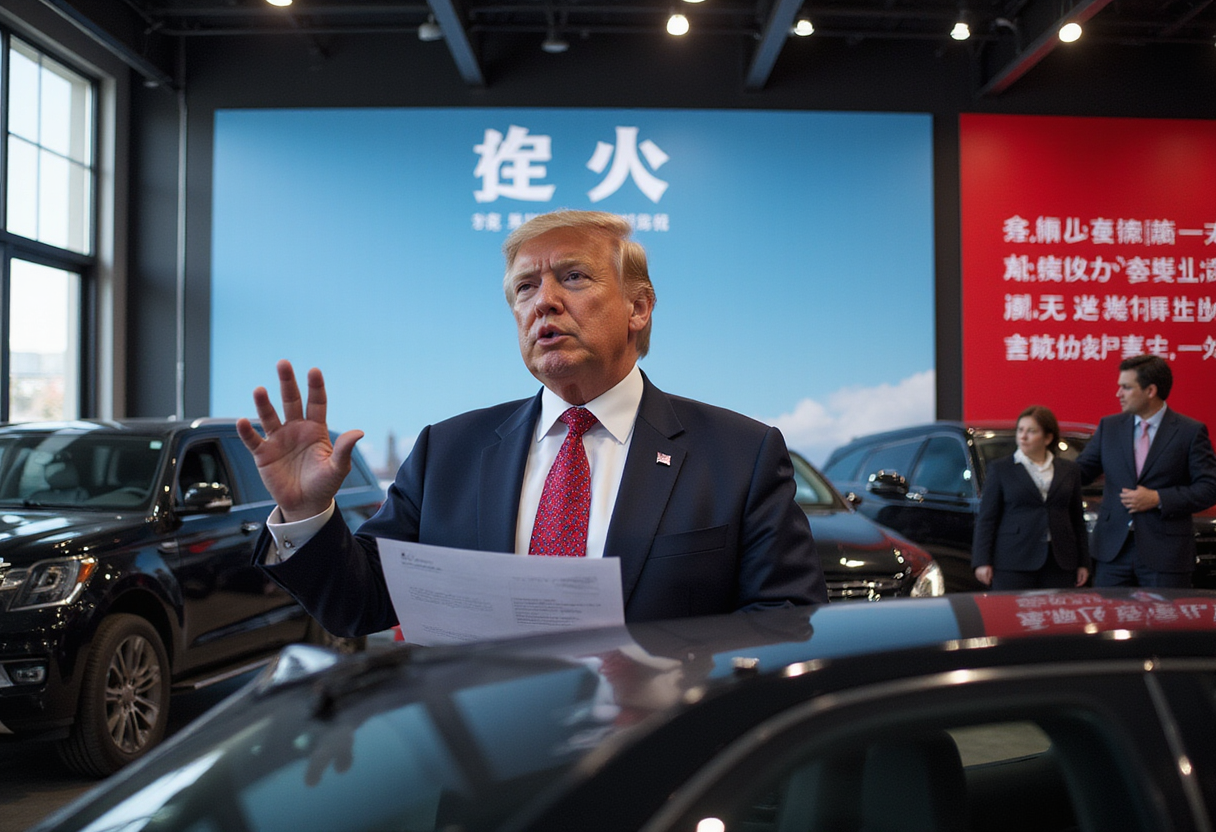
The U.S. auto industry has formally asked the Trump administration to ban Chinese vehicles outright, Axios reported — an escalation beyond the tariff walls already in place and a direct appeal for exclusion of Chinese-branded cars from the American market altogether.
The request places the White House at a decision point with consequences for every assembly plant and supplier park in North America. A prohibition, if enacted, would not change next quarter's build plans at Ford, GM or Stellantis plants. It would instead redraw the boundary of who can sell into the U.S. market, and therefore who can justify building U.S. capacity at all.
The industry's plea follows years of mounting pressure on domestic manufacturers. Chinese automakers — BYD foremost among them — have scaled production at a pace U.S. plants cannot currently match, exporting aggressively into Europe, Southeast Asia and Latin America. U.S. incumbents have watched those export markets close to them while their home market stayed protected by tariffs on Chinese imports.
A ban would lock that protection in place legislatively rather than administratively. That distinction matters for plant planners. Tariffs can be negotiated down, targeted at specific models or adjusted by executive order. A statutory or regulatory prohibition is harder to unwind, and it would signal to supplier boards that investment in U.S.-market tooling carries lower competitive risk.
It also carries risk of retaliation. China remains a critical market and production base for several U.S.-aligned automakers and Tier 1 suppliers, including General Motors through its SAIC joint venture and Ford through exported models built in China. Any prohibition Beijing reads as a market closure invites countermeasures against U.S.-built vehicles and components shipped into China — a hit to export-focused U.S. plant utilization.
For Tier 2 and Tier 3 suppliers, the calculus is mixed. U.S. stampers, molders and electronics makers gain if a ban removes the threat of Chinese vehicles arriving with vertically integrated Chinese supply chains attached. But suppliers with Chinese customers or Chinese-sourced inputs face cost pressure and potential exclusion from programs that continue on both sides of the divide.
The industry's appeal to the president also puts distance between the automakers and the tariff regime already in force. Executives have publicly supported strong trade barriers while privately weighing the cost of Chinese rare-earth controls and component restrictions that have complicated some U.S. build schedules this year. A full ban is the maximalist version of a policy the industry has already accepted in part.
What to watch next: whether the administration converts the industry's request into formal rulemaking, what China's retaliation looks like if it does, and whether any prohibition includes Chinese-built vehicles sold under non-Chinese brands — the scenario with the greatest direct impact on existing North American production programs.
via Google News: Auto industry policy (Source)
More from Daniel Okafor
Show full bio
Senior reporter covering marketplaces and e-commerce at Autoplant Brief.
111 articles
Also circulated
- US Auto Industry Presses Trump to Bar Chinese Carmakers
- Auto Industry Presses Trump to Block Chinese Automakers Before Xi Talks
- Tariffs, Chinese Rivals and EV Slowdown Drag Auto Sector Into Losses
- Canada Courts Chinese EV Makers as Tariffs Fracture Auto Trade
- Auto Industry Pressures Trump to Block Chinese Automakers