ECO-6105 · REV Z · effective November 11, 2026
Industry Analysis & MarketsRELEASEDEngineering notice
Samsung SDI Pivots to ESS as EV Battery Drag Persists
ESS is forecast to deliver 1.28 trillion won of Samsung SDI's 2025 operating profit — 82% of the total — as US capacity grows from 19 to 32 GWh and EV batteries stay loss-making.
Scope of change
- ESS expected to contribute 1.28 trillion won, 82% of Samsung SDI's forecast 2025 operating profit of 1.5739 trillion won
- US ESS capacity set to expand from 19 GWh end-2024 to 32 GWh end-2025; over 60 GWh of this year's 120 GWh-plus order target secured
- StarPlus Energy's LFP ESS line began mass production in November; line booked through 2028 production volumes
- AMPC tax credits estimated at 1.14 trillion won, 72% of 2025 forecast operating profit
- Shares fell 23.9% in three sessions this month, from 545,000 to 415,000 won
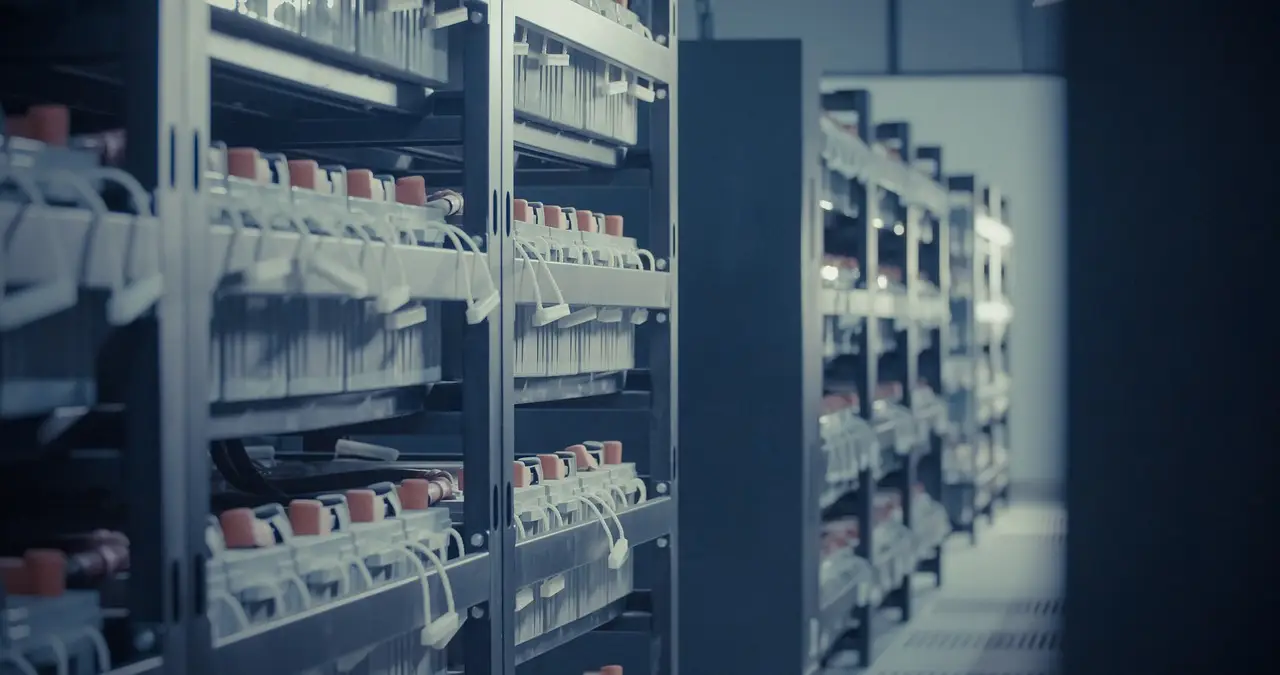
Energy storage systems will generate an estimated 1.28 trillion won ($890 million) of Samsung SDI's operating profit next year — 82% of the company total — while the EV battery business loses roughly 100 billion won. That is the core of the bull case sell-side analysts in Seoul have built around the Korean battery maker, whose shares fell 23.9% in three trading days this month, from 545,000 won on December 4 to 415,000 won on December 9.
Shinhan Investment & Securities analyst Lee Jin-myung forecasts total operating profit of 1.5739 trillion won for 2025, up 154% from this year. The rebound hinges almost entirely on ESS (energy storage systems — equipment that stores electricity and releases it to smooth intermittent solar and wind output and relieve grid peaks) sold into the North American market.
Why the US grid is the growth engine
Two structural forces are working in Samsung SDI's favor. First, Washington's push to exclude China from the battery supply chain. Hana Securities analyst Kim Hyun-soo said subsidy and tariff de-China conditions are concentrating orders with Korean companies holding US production capacity. "De-sinicization is a trend that will not change regardless of political party, so sustained benefits are expected," Kim said.
Second, AI data centers are building their own power supplies. iM Securities analyst Jung Won-seok sees BTM generation (Behind the Meter — on-site generation and storage serving a facility directly) as a realistic alternative while projects wait for grid connection. "Given gas turbine supply constraints and operating cost reduction, a structure combining gas power with solar and ESS is highly likely to expand," Jung said. iM Securities estimates that if grid-side ESS demand growth rises from 3% to 5% annually, total North American demand in 2030 would hold near prior forecasts even if data-center ESS demand comes in 30% below expectations.
What does this change for the production footprint?
US ESS capacity is set to grow from 19 GWh at the end of this year to 32 GWh by the end of 2025, according to Shinhan. Stellantis joint venture StarPlus Energy's LFP (lithium iron phosphate) battery line for ESS started mass production in November, with finished-product deliveries due in January.
Order momentum supports the ramp. Samsung SDI targeted more than 120 GWh of new ESS orders this year and has secured over 60 GWh so far, iM Securities reports. StarPlus Energy's existing line is booked through volumes scheduled for 2028 production. Jung expects Q4 ESS revenue of about 1.9 trillion won — the first quarter in which ESS revenue exceeds automotive batteries.
Jung also upgraded the secondary battery sector from neutral to overweight, naming Samsung SDI his top pick. "The share price correction caused by policy uncertainty needs to be used as an opportunity to increase weight in battery cell companies with high profit growth," he said. Higher shipments should combine utilization-driven fixed-cost relief with growing AMPC benefits, he added.
The caveats: tax credits and one-offs
The AMPC (Advanced Manufacturing Production Credit — a US tax break for advanced-manufacture products including batteries made and sold in the US) does heavy lifting. Shinhan pegs next year's AMPC at about 1.14 trillion won, or 72% of forecast operating profit.
Quarterly comparisons also need care. Q3 operating profit of 407.8 billion won included one-off customer compensation payments; Q4 consensus from Hana, Shinhan, Yuanta and iM ranges from 114 billion to 266.6 billion won. Yuanta analyst Lee An-na still expects underlying profit, excluding one-offs, to expand sharply quarter-on-quarter.
Dispersion among brokers is wide: 2025 operating profit forecasts span 1.3143 trillion to 1.734 trillion won, with December target prices of 667,000 won (Hana), 800,000 won (Shinhan) and 913,000 won (Yuanta).
Watch next: whether secured ESS orders convert into actual shipments and higher utilization, and whether profitability improves once AMPC is stripped out. Some analysts also argue that if victorious Democrats in last week's US midterms tighten data-center regulation, operators facing greater power, water and environmental liability could accelerate on-site generation and storage — adding, not subtracting, ESS demand.
via asiae.co.kr (Source)
More from Marcus Bennett
Show full bio
News editor covering regulation, policy and their impact on Automotive manufacturing and vehicle production at Autoplant Brief.
293 articles
Also circulated
- Chinese battery makers pass 56% of non-China EV market
- China EV battery installations hit 87.2 GWh in September as growth cools
- China Eyes Recycled EVs as Feedstock for Its EV Manufacturing Boom
- China's Battery Profit Boom Lays Bare India's EV Manufacturing Gap
- China NEV sales hit 1.823 million in September as exports jump 160%