Effective November 20, 2026
Suppliers & Tier-1sEngineering notice
onsemi's EliteSiC M4 targets 30% higher EV inverter power density
onsemi says its EliteSiC M4 platform delivers up to 35% lower losses and 30% higher power density. A 750-volt chip is available; 1,200-volt versions are expected from 2027.
Scope of change
- onsemi says EliteSiC M4 delivers up to 30% higher power density and up to 35% lower losses.
- Specific on-resistance is reduced 20% to 50%, while switching performance improves 67% in hard-switching and 50% in soft-switching applications.
- The first M4 variant is available as a 750-volt bare chip; versions up to 1,200 volts are expected from 2027.
- onsemi plans to qualify EliteSiC M4 for operating temperatures of 185°C and above.
- Subaru is evaluating EPP, which onsemi says can deliver up to four times higher traction-inverter power density and up to 15% lower power losses.
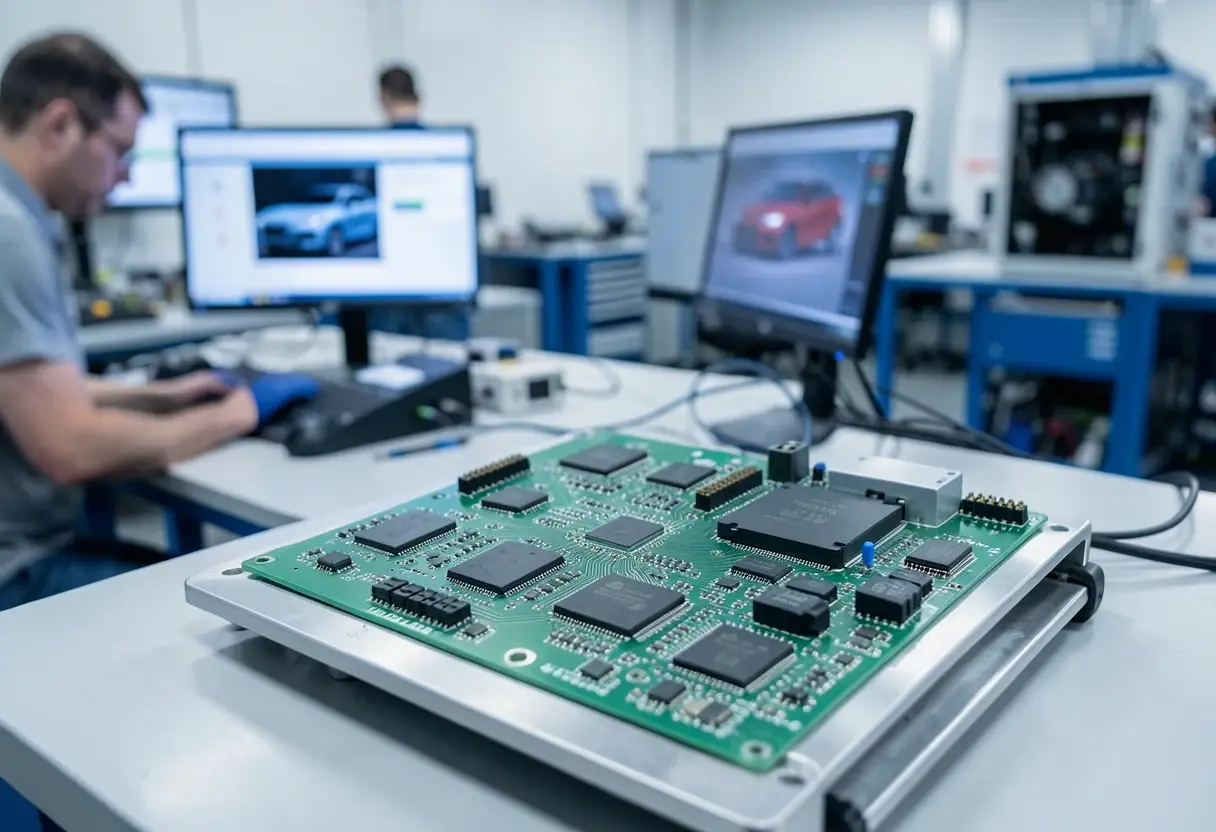
onsemi says its new EliteSiC M4 silicon carbide (SiC) semiconductor platform delivers up to 30% higher power density and up to 35% lower losses than the preceding generation.
The company says M4 uses a trench architecture—a revised semiconductor structure—to reduce conduction losses, energy lost while current flows, and switching losses during device transitions. The platform targets electric-vehicle manufacturers seeking smaller, more efficient traction inverters.
A traction inverter converts direct current from the battery into alternating current for the electric motor. onsemi says M4 can maintain the same inverter power output in a smaller package while requiring less cooling. Higher conversion efficiency could also reduce energy consumption and extend range, although the announcement provides no vehicle-level results.
What does EliteSiC M4 change for EV makers?
For EV program teams, the immediate change is access to a semiconductor platform, not a committed vehicle program or production ramp. onsemi identifies no automaker adopting M4 and discloses no production volume, manufacturing-site allocation or vehicle launch date. That leaves its performance figures as company claims pending validation in inverter assemblies and vehicles.
onsemi reports the following semiconductor-level changes:
- Specific on-resistance, the chip's electrical resistance, is reduced by 20% to 50% compared with the previous generation.
- Switching characteristics improve 67% in hard-switching applications.
- Switching characteristics improve 50% in soft-switching applications.
onsemi states that these figures describe technical parameters of the semiconductors and do not translate directly into equivalent reductions in losses across an entire powertrain. In other words, the 35% headline is not a 35% vehicle-efficiency gain.
The platform supports existing top-side cooled SMD (surface-mount device) packages and power modules, or packaged semiconductor assemblies. Its first available variant is a 750-volt bare chip, meaning an unpackaged semiconductor, for EV traction inverters. No shipment volume accompanies the availability claim.
Further versions covering voltages up to 1,200 volts are expected from 2027. For demanding applications, onsemi plans to qualify the technology for operating temperatures of 185°C and above. That is a future qualification target, not a stated qualified operating limit for the available product.
Automotive supplier Schaeffler reinforces the same priorities. Harald Hartel, vice president of its eMotor Controls Business Unit, sees “additional opportunities to optimise inverters in terms of range, heat generation, and installation space.” His statement aligns with onsemi's claims but does not constitute an order, vehicle award or production commitment.
Separately, onsemi presented its Embedded Power Platform (EPP) as early as September 2026, describing it as a new architecture for power electronics. Unlike M4, which changes the electrical properties of silicon carbide semiconductors, EPP focuses on integrating and packaging different semiconductor technologies within a shared architecture.
For traction inverters, onsemi promised up to four times higher power density and up to 15% lower power losses at the time of that announcement. Subaru is among the first development partners and is evaluating EPP for future electrified vehicle architectures. Current announcements do not clarify whether or how EPP and M4 could be combined.
EliteSiC M4 also targets data centres and energy applications, including photovoltaic systems and battery storage. onsemi expects lower conversion losses to help power-electronics systems become more efficient and compact in those markets.
What to watch next: onsemi must complete the planned 185°C qualification, release further M4 versions for voltages up to 1,200 volts from 2027, and disclose customer vehicle launch dates, order volumes and a production-capacity milestone. Subaru's EPP evaluation will show whether the packaging architecture advances toward a vehicle program.
Until then, M4 offers onsemi's claimed chip-level efficiency gains around an available 750-volt part. EPP remains under evaluation, and the two technologies' potential combination remains undefined.
via electrive (Source)
More from Grace Kim
Show full bio
Staff writer covering people, launches and day-to-day practice in Automotive manufacturing and vehicle production at Autoplant Brief.
299 articles
Also circulated
- Infineon processes SiC on 300 mm wafers for first time in Villach
- GAC's amorphous-stator motor wins top Geneva prize, adds 30–50 km
- Xiaomi Registers New Subsidiary for EV Battery Powertrain Production
- Valeo and Mahindra Partner on EV Powertrain Manufacturing in Pune
- Valeo adds e-powertrain line at Pune site