ECO-2132 · REV W · effective October 9, 2026
EV Manufacturing TransitionAPPROVEDEngineering notice
Mercedes-Benz Trucks fits eActros 600 Lowliner under 4-metre EU cap
Mercedes-Benz Trucks has unveiled the eActros 600 Lowliner, a tractor variant repositioned to fit Europe's 4-metre height cap, while Daimler Truck plans to scale its GenH2 fuel-cell customer fleet from 5 to 100 units.
Scope of change
- Mercedes-Benz Trucks debuted the eActros 600 Lowliner, engineered to fit under Europe's 4-metre total vehicle height by rotating and repositioning the battery packs
- Mercedes-Benz Trucks will offer the eActros 600 with the Megawatt Charging System from 2027; the truck exceeded 1 MW during a live test at IAA Transportation
- Daimler Truck will scale its GenH2 fuel-cell customer fleet from five vehicles to 100, shifting focus to durability, cost and series readiness
- Head of whole vehicle development Michael Scheib cited a need to transition six million trucks in the EU as the rationale for the dual-track BEV and hydrogen strategy
- Scheib put the industry-wide share of electrically powered heavy commercial vehicles in the single digits, with charging infrastructure named as the binding constraint
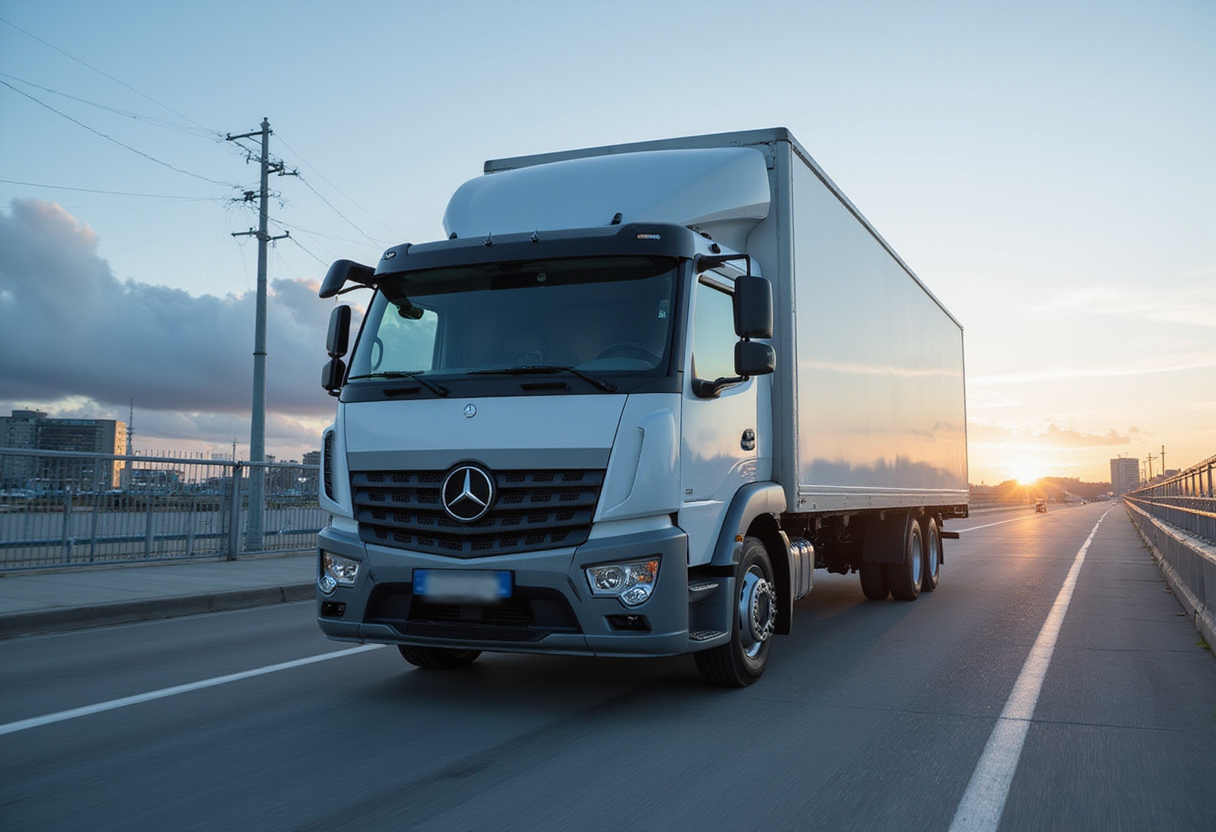
Daimler Truck will scale its GenH2 fuel-cell customer fleet from five vehicles to 100, Michael Scheib, head of whole vehicle development at Mercedes-Benz Trucks, said at IAA Transportation in Hanover. The manufacturer is pushing battery-electric and hydrogen drivetrains in parallel.
The expansion marks the next industrialisation step for the fuel-cell programme. Five GenH2 trucks have run in customer operations to date. Scheib said the next phase will focus on long-term durability, cost reduction and series readiness. "That means our task is to optimise the vehicle for durability, achieve a cost position that allows us to produce it in series and sell it to our customers," he said.
Mercedes-Benz Trucks used IAA to debut the eActros 600 Lowliner, a tractor variant engineered to fit within Europe's 4-metre total vehicle height. To bring the fifth-wheel height down, engineers rotated and repositioned the battery packs rather than shrinking them. "This is the development magic we've achieved here," Scheib said. Engineers also re-routed charging hardware and high-voltage components inside the frame.
What does the Lowliner change in the line-up?
The Lowliner opens the eActros 600 to volume-transport fleets that run tall trailers and could not previously specify the standard battery-electric tractor. It leads a wider specialist-application push covering refuse collection vehicles, additional tractor variants and the eArocs. "We have now broadened our range, and all the vehicles deliver performance on a par with diesel trucks," Scheib said.
When does megawatt charging reach the eActros 600?
Mercedes-Benz Trucks will offer the eActros 600 with the Megawatt Charging System from 2027. During a live test at the fair, the truck exceeded 1 MW. Scheib argued the charging rate extends BEV duty cycles by enabling drop-and-hook operations: tractors charge at high power while trailers unload, then pick up a new trailer. "This allows us to enable almost every use case," he said.
Why does Daimler Truck keep funding hydrogen?
Scheib tied the parallel battery-electric and fuel-cell tracks to the size of the EU commercial-vehicle parc. "We have a clear dual-track strategy because we firmly believe that to truly transition six million trucks in the EU to sustainable transport, we need two technologies — both for infrastructure reasons and use-case reasons," he said. He sees hydrogen as the fit for long-distance routes at high payload.
Mercedes-Benz Trucks also backs liquid hydrogen. Scheib argued gaseous hydrogen becomes harder to distribute as station throughput rises, while liquid H2 supports long range at high payload. For shorter or lighter-duty cycles, the manufacturer routes customers to BEVs. "And then we say, for those, there's a battery-electric vehicle, and for long distances with high payloads, there's the hydrogen-based vehicle," he said.
What is slowing the electric ramp-up?
Scheib put the industry-wide share of electrically powered heavy commercial vehicles in the single digits and pointed to charging infrastructure as the limiting factor. He expects a step-change toward 2030 only if both drive paths continue.
What to watch next
- 2027 series availability of the eActros 600 with Megawatt Charging System
- Scaling of the GenH2 fleet from five to 100 customer-operated vehicles, with focus on durability and unit cost
- Additional Lowliner variants and further BEV product launches under the wider electrification push
via youtube.com (Original)
More from Grace Kim
Show full bio
Staff writer covering industry trends and analytics at Autoplant Brief.
133 articles
Also circulated
- Volkswagen Group starts production of new MEBeco electric drive
- BMW Starts Powertrain Production for Neue Klasse Platform
- Mercedes-Benz gains preferential access to ProLogium Gen4 battery cells for testing
- BMW outlines Gen6 battery production at South Carolina's Plant Woodruff
- BMW Steyr Converts V8 Lines to Fuel Cell Output for 2028 iX5