ECO-7177 · REV P · effective October 9, 2026
Vehicle Plants & ProductionRELEASEDEngineering notice
Hyundai's $12B Georgia Metaplant Named 2026 Assembly Plant of the Year
Hyundai's $12B Metaplant America in Ellabell, GA, claims the 2026 Assembly Plant of the Year title. The 2,900-acre complex runs 1,000+ robots and targets 580,000 vehicles annually across 10 models.
Scope of change
- $12 billion invested across the 2,900-acre HMGMA complex in Ellabell, GA
- Long-term annual capacity target: 580,000 vehicles across up to 10 models
- More than 1,000 robots in operation, including 600 welders performing 95% of body-shop joining
- Three models assembled today—Ioniq 5, Ioniq 9, Kia Sportage hybrid—with a fourth slated for 2026
- Site staffing planned to reach 8,500 employees by 2030
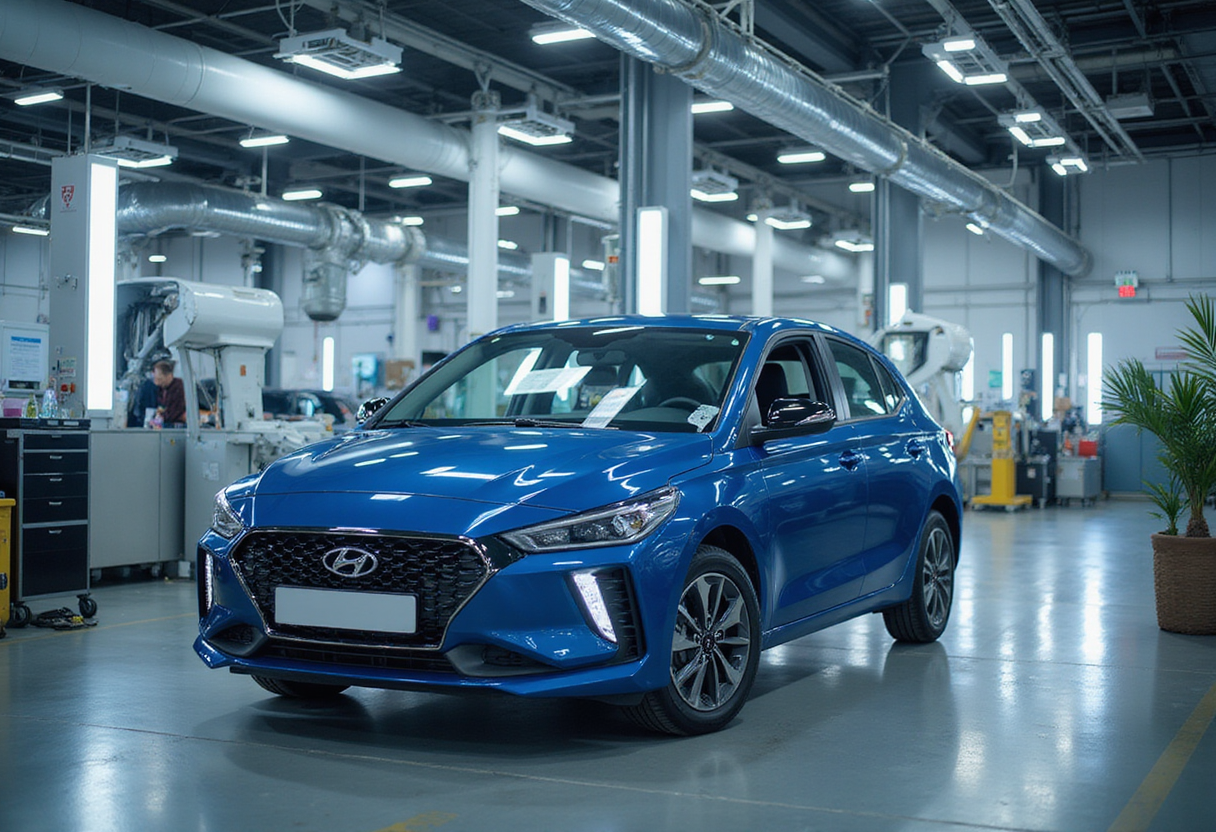
Hyundai Motor Group Metaplant America (HMGMA), the $12 billion assembly complex rising on 2,900 acres in Ellabell, GA, has been named ASSEMBLY Magazine's 2026 Assembly Plant of the Year. The 30-month-old facility, located 30 miles west of Savannah, is Hyundai's first dedicated EV plant in the United States and is currently scaling toward a long-term ceiling of 580,000 vehicles annually across as many as 10 nameplates.
The site assembles three models today—the Hyundai Ioniq 5, the three-row Ioniq 9 and the Kia Sportage hybrid—on two parallel lines in a 1-million-square-foot general assembly building. A fourth model is slated to join the mix in 2026, with Genesis vehicles planned to follow.
What does the $12 billion buy?
Eleven air-conditioned buildings spanning more than 7 million square feet, a 3,000-foot glass-enclosed bridge connecting paint to final assembly, and an 89,000-square-foot training center that can take 824 trainees through simultaneous classes. On-site amenities include a fire station, a 1.25-mile test track, a medical center, an ecological park under construction, and a solar-panel-covered lot that supplies roughly 5 percent of site electricity. Hyundai plans to staff the campus with 8,500 people by 2030.
"AI, real-time data, robotics and automated logistics are utilized throughout the production process," says Tony Heo, president and CEO of HMGMA. "The facility was built to be more flexible, allowing us to more efficiently make changes to our line and model mix."
How extensive is the automation?
More than 1,000 robots operate across the site. The body shop runs 600 six-axis welders performing 95 percent of joining tasks, and 161 automated guided vehicles transport subassemblies and complete bodies. The general assembly line carries more than 100 robots—roughly eight times the count found in a typical auto plant.
Two flexible assembly lines flow in a horseshoe layout, each with 116 workstations spaced an average of 20 feet apart. One line runs the high-volume Ioniq 5; the other builds the Ioniq 9 and Sportage hybrid. Cordless, 5G-connected fastening tools stop automatically at the correct torque spec and feed data to a smart factory platform. The trim line runs an AI-vision "one-kit" parts check that the group first deployed in Piracicaba, Brazil, and Ulsan, South Korea.
The plant operates what it calls the industry's first robotic door-installation station on a moving line: 14 six-axis robots with AI cameras pick, align and drive fasteners, then verify door fitment. End-of-line testing is handled by Hyundai Wia parking robots that lift vehicles weighing up to 3.4 tons and transport them at 1.2 meters per second to cobot-equipped inspection stations.
Who supplies the campus?
Vertical integration runs deep on the metaplant grounds. Hyundai Steel blanks coils on site and feeds Hyundai Rotem servo presses; Hyundai Wia builds the AMRs and parking robots; and Boston Dynamics—the Hyundai-owned quadruped maker—runs two Spot robodogs in the body shop for weld inspection. Starting in early 2028, next-generation Atlas humanoids will join parts sequencing; broader assembly applications are possible by 2030.
Hyundai Mobis runs its largest global plant on the campus, with annual capacity of 300,000 battery systems plus cockpit, front-end, chassis and power-electronics modules. Adjacent, Hyundai Transys assembles 420,000 seats per year. A joint-venture battery cell facility with LG Energy Solution operates at 30 gigawatt-hours—enough for roughly 360,000 EVs based on the 84-kWh Ioniq 5 pack. Twenty-two tier-1 suppliers are expanding or building operations nearby.
What to watch next?
HMGMA has added a second shift in support of the 2026 fourth-model launch. Key markers to track:
- The fourth nameplate's debut on the second assembly line and how Ioniq 5, Ioniq 9 and Sportage volumes rotate behind it
- Confirmation that Hyundai's U.S.-production target—80 percent domestic by end of decade, up from roughly 40 percent in 2024—holds as EV demand evolves
- The 2028 Atlas humanoid rollout at HMGMA and how quickly the program migrates from parts sequencing into repetitive-motion assembly
- Whether Hyundai pulls its 580,000-unit ceiling forward of 2030 as U.S. battery sourcing ramps in Georgia and Louisiana
"Hyundai is accelerating across North America," says José Muñoz, president and CEO of Hyundai Motor Co. The metaplant will determine how much of that growth the group can claim on its own soil.
via bnpmedia.com (Original)
More from Daniel Okafor
Show full bio
Senior reporter covering marketplaces and e-commerce at Autoplant Brief.
176 articles
Also circulated
- Hyundai Metaplant Takes 2026 ASSEMBLY Plant of the Year Title
- Hyundai puts US$500M into hybrid output at Alabama plant
- Hyundai Pairs People With Robots At Georgia Metaplant
- Kia earmarks $649 million for a dedicated Mexico EV plant
- Hyundai Targets 25,000 Atlas Humanoids as Boston Dynamics Opens Metaplant Center