ECO-7498 · REV M · effective September 30, 2026
Automation & RoboticsAPPROVEDEngineering notice
Assembly Magazine Reports Robots Taking On Difficult Automotive Assembly Task
Assembly Magazine reports robots applied to a difficult automotive assembly operation. Trade coverage puts automation claims to the test against cycle time and quality data.
Scope of change
- Assembly Magazine published a report titled "Robots Automate Tough Automotive Assembly Project"
- The report concerns robotic automation of an automotive assembly operation previously considered difficult to automate
- Specific plant, OEM, supplier, and production figures were not available in the headline-level information reviewed
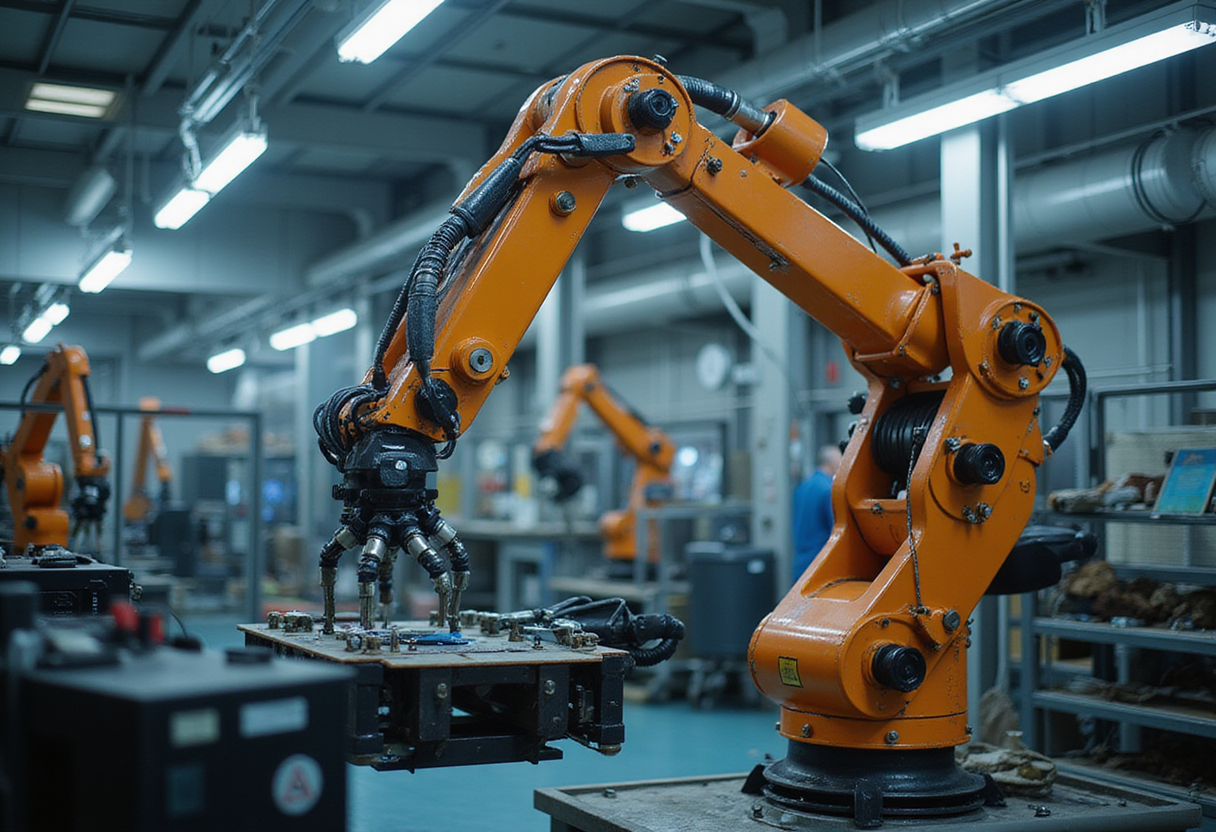
Assembly Magazine has published a report on a robotics deployment targeted at one of the harder jobs on an automotive assembly line, under the headline "Robots Automate Tough Automotive Assembly Project."
The headline signals a familiar pattern in plant automation: manufacturers and their integrators increasingly apply robotic cells to assembly operations that resisted automation for years. These are typically tasks involving flexible parts, tight tolerances, high cycle-time pressure, or ergonomically difficult manual work — the operations that plant engineers have historically left to human operators because the variability of the parts or the process made fixed automation impractical.
What the reader of that report will want to establish first is the specifics: which OEM plant, which tier-one supplier, and which assembly operation. In trade coverage of this kind, the credibility of the claim rests on three concrete anchors. The first is the process itself — fastening, sealing, part insertion, torque-critical joining — and why it was previously done manually. The second is the system integrator and robot supplier involved, since the difficulty of automating a task usually lives in the end-of-arm tooling, vision system, and force-control software rather than in the robot arm. The third is the production metric: cycle time achieved, throughput per shift, or defect-rate improvement against the manual baseline.
Without those anchors, an automation announcement functions as a claim rather than a confirmed production result. Supplier and vendor announcements of this type warrant verification against actual line data — takt time, first-pass yield, and uptime over a sustained production run — before the deployment counts as proven. Assembly Magazine's coverage, as a trade publication serving manufacturing engineers, typically walks through the engineering problem and the solution applied, which is exactly the level of detail a plant-side audience needs.
The broader context matters here. Automakers have spent the past several years pushing automation deeper into final assembly — the segment of the plant that remained heavily manual even after body shop and paint shop automation reached maturity. Automotive News and Automotive Manufacturing Solutions have both tracked this trend across North American, European, and Asian plants, driven by three pressures: persistent labor shortages in manufacturing, rising volumes of product variants that strain manual stations, and quality requirements on torque-sensitive and adhesive-bonded joints that exceed what human operators can hold consistently across a shift.
For plant managers and manufacturing engineers evaluating similar projects, the questions to put to any integrator pitching a comparable cell are straightforward. What was the manual cycle time, and what does the robotic cell achieve? How does the system handle part variation and presentation? What is the measured change in rework and scrap? And what does uptime look like after the first six months of production, not during launch week?
What to watch next: the full details in Assembly Magazine's report — the plant, the process, the robot supplier, and the cycle-time numbers — and whether the deployment scales from a single cell to a full line application at the same facility.
via Google News: Automotive assembly automation (Source)