ECO-4246 · REV A · effective November 10, 2026
Automation & RoboticsAPPROVEDEngineering notice
97% Success Rate: Dongfeng's AI Robot Grasps Loose Bolts at Scale
Dongfeng and Huazhong University engineers built a YOLOv8-based vision system that lets a six-axis robot pick loose bolts at 97% success, 8.73-second cycles — validated over 1,300 pick-and-place moves.
Scope of change
- Robot achieved 97% grasp success rate at 8.73-second average cycle time across 1,000+ pick-and-place trials.
- System recognizes five bolt types using a modified YOLOv8 detector with E-C2f, LCA and SA-PAN modules.
- Hand-eye calibration error was held within 0.217 mm; robot repeatability was ±0.05 mm.
- Success ranged from 98.5% for the largest bolt to 95% for the smallest.
- Research was co-authored by Dongfeng Motor Corp. R&D Institute and Huazhong University of Science and Technology, Wuhan.
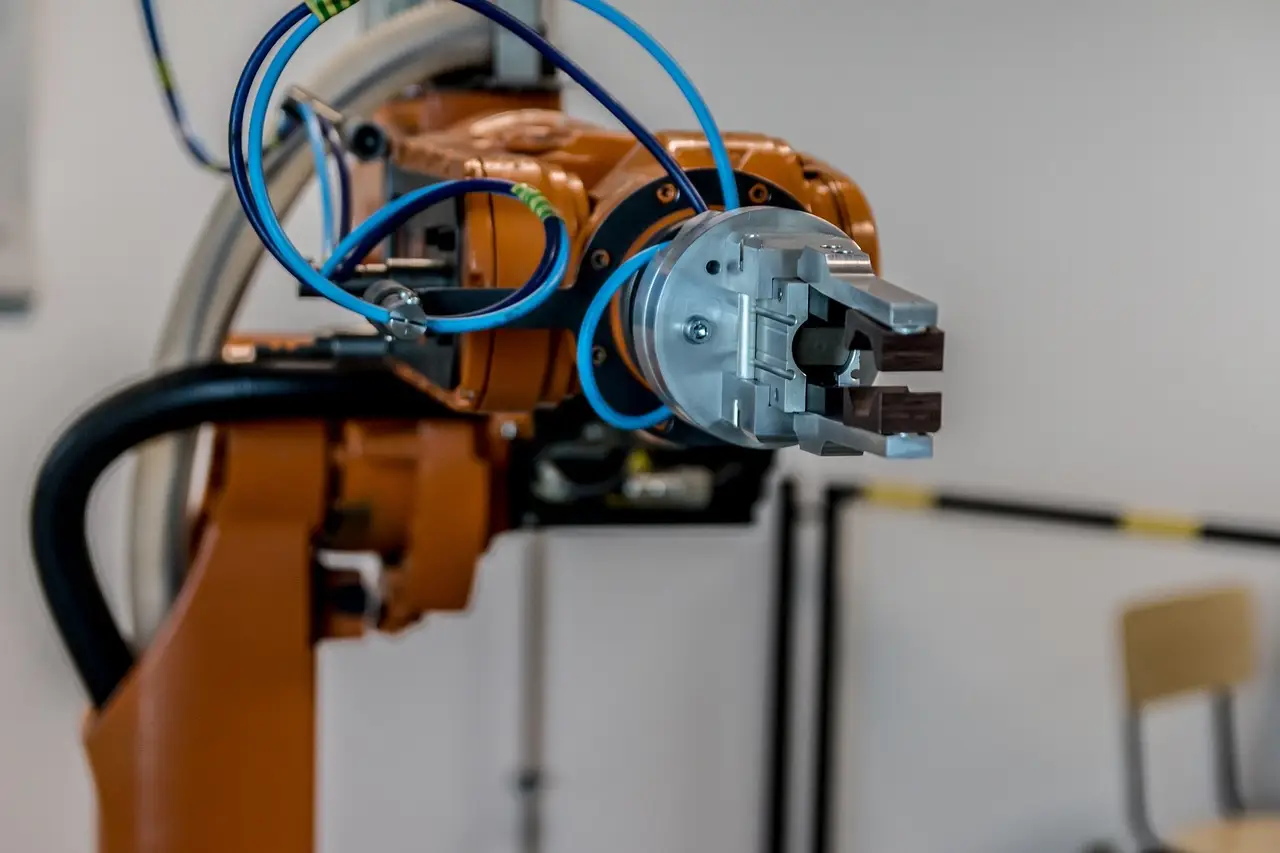
A robot picking loose bolts from a pile achieved a 97 percent grasp success rate at an average cycle time of 8.73 seconds — numbers that came out of a joint research effort between Dongfeng Motor Corp.'s Research and Development Institute and Huazhong University of Science and Technology in Wuhan.
The researchers — Long Liu and Yingze Xi at Dongfeng, and Pengzhan Fu, Xingwei Zhao and Xuan Wang at Huazhong — set out to solve a stubborn automation problem. Picking small bolts in high-mix, low-volume assembly is hard for people. For robots, the paper notes, "it's almost impossible." Conventional vision systems struggle with the weak textures and reflective metallic surfaces of fasteners.
What did the team actually build?
The test rig is straightforward: a six-axis robot, a camera mounted above the gripper, and a choice of two end-effectors — an electric parallel gripper or a five-finger dexterous hand. An Intel RealSense D435i depth camera supplies per-pixel depth measurements, with hand-eye calibration error held within 0.217 millimeter and robot repeatability of ±0.05 millimeter.
The software side is where the novelty sits. The team built a detector on the YOLOv8 architecture — "You Only Look Once," the real-time detection model family introduced in 2015 that reframed object detection as a single regression problem rather than a multistage classification pipeline.
Why modify YOLOv8?
Stock YOLOv8 wasn't enough. Bolts are small, elongated, visually similar, and often lying in random orientations. So the researchers made three changes:
- Efficient C2f (E-C2f) backbone module: replaces standard convolution with grouped, depth-wise convolution to preserve thread details and slender boundary structures while cutting redundant background information.
- Lightweight channel attention (LCA): recalibrates channel responses via global average pooling and sigmoid activation, strengthening thread and contour features at negligible computational cost.
- Scale-adaptive path aggregation network (SA-PAN) and WD-IoU loss: the neck network learns which feature scales matter; the weighted distance IoU loss tightens center-distance constraints for long, slender bolts — critical because the bolt's center position directly drives grasp-point generation.
The system had to distinguish five different bolt types.
How was it tested?
The validation was thorough. Single-bolt trials ran each bolt category, placement position and end-effector combination 50 times — 1,000 pick-and-place operations in total. Multi-bolt trials presented three to six bolts in random positions, tested across three target-selection strategies (any bolt, best-position bolt, nearest bolt), with each scenario run 100 times for another 300 moves.
Results by bolt size ranged from 98.5 percent success for the largest bolt to 95 percent for the smallest. Density mattered little: success rates for three-, four-, five- and six-bolt scenes were 98.7 percent, 97.3 percent, 96 percent and 96 percent respectively. The nearest-bolt strategy delivered the shortest cycle time but raised interference risk; the best-position strategy won on reliability while staying competitive on speed.
Failure modes were honest and specific: grip slip on small or horizontal bolts, depth errors from metallic reflection, occasional detection misses on blurred edges, and a few placement deviations from gripper rebound.
Why geometry instead of deep-learning grasps?
The team deliberately avoided heavy grasp-prediction networks such as GraspNet or GG-CNN. Bolts have regular geometry, enumerable categories and a known operating plane — conditions where, as the paper puts it, "a grasping strategy based on visual detection and localization followed by geometric, rule-based pose determination is better than deep learning." The robot clamps the middle of the shank, near the center of mass, so the bolt hangs vertically and self-stabilizes during transport. Grasping at the head, by contrast, creates a cantilever prone to oscillation at speed.
The parallel gripper outperformed the five-finger hand on cycle time thanks to its simpler closing motion.
What's next?
The researchers are candid about limits: trials ran in structured or semi-structured settings. Strong occlusion, severe clutter, highly reflective surfaces and mixed-object manipulation "remain challenging." The paper points to force-feedback grasp verification, more robust depth filtering and denser collision checking as future work. For assembly plants running high-mix fastening lines, the 97 percent figure sets a benchmark — watch whether it survives a real feed hopper.
via mdpi.com (Original)
More from Daniel Okafor
Show full bio
Senior reporter covering regulation, policy and their impact on Automotive manufacturing and vehicle production at Autoplant Brief.
330 articles
Also circulated
- Stellantis Cuts Bolt Miss Rate 10-Fold With Inbolt Vision Guidance
- Queretaro Researchers Report 95.8% Accuracy on Spot Weld AI Inspection
- From Demo to Deployment: Video Series Tests Robot Claims Against Plant Reality
- IFR President: Stop Asking If Robots Can Beat the Human Hand
- Google's Intrinsic Open-Sources Robot Control and Vision Software